
Intuition and Instinct
Justice for late summer, using fish to tell the future, and giving yourself permission to move on.

I turned 28 last week. Two days before my birthday was the seven month anniversary of my fiance’s passing. A day before, his tombstone was unveiled in a cemetery in Los Angeles, one thousand miles away.
This birthday was certainly weird, being the first birthday I experienced in the After Times. I had left the apartment I shared with my fiance behind in Los Angeles, and moved into my childhood home in the Pacific Northwest for the summer. I turned 28 while in a holding pattern, trying to enjoy the respite of towering trees, suburban gardens, coffee shops where I could always find a place to sit, and beaches where I could always find a place to park … while trying not to be stressed that the path I had painstakingly constructed, once stretching out in front of me like a glittering ribbon, had been obliterated. I came here to “process”, whatever that means, and to “figure out what to do next”, whatever that means.
I’ve always found a sense of warped pleasure in the late weeks of summer. It’s a strange time of year, a holding pattern of its own. Growing up in the Pacific Northwest, the leaves on the cherry trees turning yellow at the end of August meant that the school year was coming, and with it endless months of darkness and rain. The days still drip with gold and heat while the night creeps greedily closer, the final bows of the curtain call. It’s a time that feels all the more textured and vibrant when thrown into relief by the darkness on its heels. A gasp of adrenaline that propels risk, a rabbit driven from its burrow. I’ve always turned a new age in this in-between time, glanced over, kinetic with anticipation. It always felt like I was getting away with something, like I had aged in secret, because the whole world began to turn its neck away from the carefree depths of summer and toward the regimented march of fall, when the real plot picks up again. I close my eyes as I sit on the beach, the sand radiating heat below me, the acrid smell of baking seaweed carried away as soon as it materializes by the cool breeze off the Puget Sound, and I try to make it all coalesce into … something. I try to find peace in late summer, the holding pattern, while I’m in between the gaping chasms of grief on one side, an impending return to Los Angeles on the other. I felt grief inside me like something I needed to expel, golden memories turned sour, making me sick. I wanted to crawl on all fours from the beach to the forest, find a dark corner and retch, my grief escaping from my body soft and steaming. It would make my body weak, but it would clear my mind. How can I decide what to do next, how can I formulate a new path from the rubble, when I’m hijacked again and again by this emotional fever?
Whenever I’m terribly sick, hunched over in the bathroom, I have a mantra that helps me through it- “my body is doing what it needs to do”. I wish desperately for my body to tend to this grief like it tends to an illness, like I’m an automaton, flesh over machinery, responding reflexively- output automatically to input. I watch a formation of geese fly overhead, and I’m jealous of the other creatures on this earth. I wish I had the instinct to know where home was, to orient me toward the next stage. Instead I engage with what my therapist would call “magical thinking”, and I decide that if I see more than ten salmon at the Ballard Locks on my birthday, I will have an auspicious year.
It’s hard to explain the mythic importance of salmon to Seattleites if you did not grow up in the Washington state public school system. We learn about ecology through salmon migration, we learn about civic debates by staging mock trials concerning imaginary dams which would block salmon from their spawning grounds. In my classroom, we even raised actual salmon from egg to fry, then released them into a local stream. Most Seattleites remember an elementary school field trip to the Ballard Locks, a canal which controls the ocean level by using gates to allow ships to pass between the inner lakes of the city and the ocean. Completed in 1917, the engineer Hiram M. Chittenden had the foresight to include a “salmon ladder”, a series of 21 concrete steps (or “weirs”) filled with water that allow salmon to climb up and down through the locks, along their migration path.
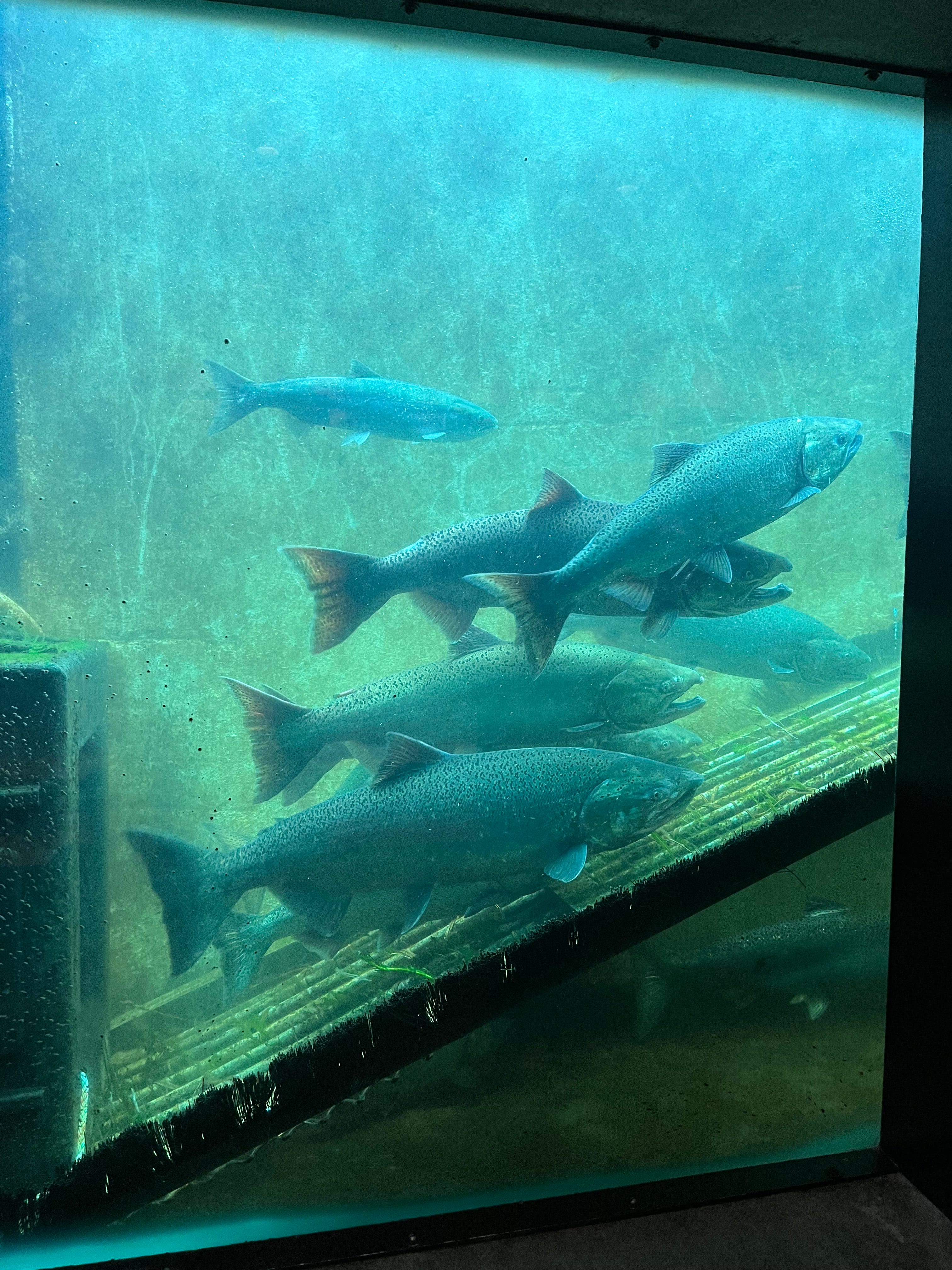
In this summer, when I was looking for something, anything to give me a sign, I found myself at the salmon ladder, witnessing an ancient migratory path on the day I completed my 28th migration around the sun. I had been to the salmon ladder before, but I had never seen it so dense with fish. I watched as they heaved their massive, silver bodies from one “step” in the ladder to the next, in one fluid-jerk motion, so fast that you would miss it if you blinked. One salmon making the leap seemed to inspire the others, as one jump would be followed by three or four more splashes, and then a period of silence as another brave fish gathered its nerve.
I overheard a child ask her mom, “how do they know where to go?” Indeed, this was the question on my mind, too: how do they know? How do salmon know how to make this 50 mile journey from generation to generation, how do geese know how to fly south in a perfect formation, how are animals able to orient themselves toward home?
I had always had this conception that animals know to do these things based on instinct. A hand-wavey explanation that you would tell a child: animals do what they do based on some sort of internal programming. They are hard wired to do the same things, the same way, over and over, species-wide. A simple matter of input and output.
However, this turns out to not exactly be the case. In the case of salmon migration, for example,
“Salmon can return to the very streams in which they were born by homing in on the distinctive scents of those natal waters. (Arthur Hasler confirmed this ability in the 1950s after having his own olfactory epiphany. While hiking near a waterfall, the familiar smells brought back long-buried childhood memories, and he wondered if migrating salmon experience something similar).” (An Immense World, Ed Yong).
In other words, it doesn’t seem as though salmon have a mindless instinct to swim up the river bed, unlocked like battleship coordinates from deep inside their ancestral DNA. Instead smell is tied to memory, perhaps not unlike how smelling the brand of cologne an unrequited crush from a decade ago wore can still send shivers up my spine. To me, this reads less like “instinct”, mindless output in response to stimuli, but “intuition”, a gut feeling based on memory, on emotion, on desire.
Ed Yong expands upon the concept of an animal’s unique perception with the idea of “umwelt”:
“... every animal can only tap into a small fraction of reality’s fullness. Each is enclosed within its own unique sensory bubble, perceiving but a tiny sliver of an immense world. There is a wonderful word for this sensory bubble – Umwelt … specifically the part of those surroundings that an animal can sense and experience – its perceptual world” (An Immense World, Ed Yong, 5).
Reading more about animal perception, how ants perceive the world through complex pheromone trails left by other ants, how dogs perceive the world through a sense of smell so sophisticated they can track the passage of time through scents left behind for days, how salmon can trek for miles upstream using the nostalgic smell of their spawning ground- I began to think about my own “umwelt”. The “small fraction of reality’s fullness” that I experience due to my unique perception. What is my metaphorical “umwelt”? Is it the Freudian iceberg of my past and subconscious and the resulting desires for intimacy, warmth, rebirth, connection? Is it the books I read, the music I listen to, the company I keep, the recipes passed down, the trust that’s been broken, the adults who were kind to me when I was small, my body telling me where it hurts, the memory of a kiss, every sunset I’ve ever witnessed?
That’s the thing about being a human- I’m not trying to use my perception to avoid predation, or hunt prey, or migrate south for the winter. I’m using it to decide what city I should live in, how I should handle my career - And, I guess, to decide on potential mates, which brings me closer to the animal kingdom …
The complexity of choices necessitates an abundance of guidance. And maybe, unlike animals, the tools we use to develop guidance can be cultivated. I read this beautiful essay from velvet noise recently about how “certain parts of you only emerge for certain people”, expanding on this article by Michael E. Johnson, which explains annealing metals:
“Annealing involves heating a metal above its recrystallization temperature, keeping it there for long enough for the microstructure of the metal to reach equilibrium, then slowly cooling it down, letting new patterns crystallize.” (Johnson)
Johnson goes on to compare the annealing of metals to the annealing of the mind. In a “high energy state” such as being under the influence of psychedelics, or in deep meditation, the mind can “anneal”, literally reshaping deeply entrenched neural pathways. He hypothesizes that being in love may cause a similar effect:
“...perhaps we can describe love as the result of a strong annealing process while under the influence of some pattern. I.e., evolution has primed us such that certain intentional objects (e.g. romantic partners) can trigger high-energy states where the brain smooths out its discontinuities/dissonances.” (Johnson)
I think anyone who has been in love has experienced this. You start to adopt the other person’s mannerisms, their speech patterns, even their lifestyle and ambitions, (or lack thereof…). I’ve felt that grief has a similar effect. My entire world has been remade, it makes sense that my mind is being remade too. It’s striking to me how similar grief feels to falling in love- the literal pain in your heart is the same twinge of a new crush, magnified a thousand times. And just as we should be judicious about who we let into our heart, who we let remake us, I’ve been judicious about what I let guide me through this grief. The people who’s advice I listen to, the books and poems I read, the new people I let into my life.
Thus, in a sense, perhaps intuition can be cultivated. In order to trust my decisions, I need to know that I can trust the “umwelt” that I have created for myself. When I am happy with my friends, with the work I put in to understanding myself and my fears, with the health of my body, with the quality of the art and media I engage with, then maybe I can let myself trust my gut feelings. Because the truth is, the body usually knows what is right for you before the mind catches up. For me, making the right choice has often felt like asking for permission to do what I already knew was correct. Like, I didn’t know, but I knew.
In grief, I’m asking for permission all the time. There’s a guilt in surviving when your loved one was unfairly taken from the world, and it can cloud my judgement. Dearly departed, am I allowed to be happy again? Dearly departed, can I take the care I used to give to you, and can I give it to someone else?
I saw decidedly more than ten salmon on my birthday. I couldn’t tell you how many salmon I saw, their bodies slipping over one another. Dearly departed, am I allowed to love again? Am I allowed to start that perilous journey from the ocean to the spawning grounds? My mind is afraid but my body remembers how it felt to be loved, I am drawn back to it, and it feels like surrender.
“My great happiness / is the sound your voice makes / calling to me even in despair; my sorrow / that I cannot answer you / in speech you accept as mine. / You have no faith in your own language. So you invest / authority in signs / you cannot read with any accuracy. / And yet your voice reaches me always. / And I answer constantly, my anger passing / as winter passes. My tenderness / should be as apparent to you / in the breeze of the summer evening / and in the words that become / your own response.” (Sunset, Louise Gluck).
Your writing is so beautiful
Please take that 'care' and give it to yourself. Your writing is moving and took me to the salmon run from my visit in 2003. I look forward to your published work.