
What To Do With the Memory
What mysticism do you allow yourself?

“One who regards one’s intellectual knowledge as ignorance has deep insight.
One who overrates one’s intellectual achievement as definite truth is deeply sick.
Only when one is sick of this sickness can one cease to be sick.
One who returns one’s mind to the simplicity of the subtle truth is not sick.
One knows to break through conceptual knowledge in order to directly reach the subtle
truth of the universe.”
Tao Te Ching, Verse 71, Translated by Hua-Ching Ni
The day after my fiancé’s funeral, my neighbor was having a yard sale. Our street was surprisingly quiet for being tucked between Fountain and Sunset, two major thoroughfares. We lived in one 1920’s Spanish colonial style fourplex among many, the sidewalks lined with sweetgum trees. It was the type of apartment I had dreamed of living in one day. I would have to move out of it seven months later.
My neighbor Pheobe was one of those home grown, hardened hippie Angelinos. She gave the neighborhood a sort of old school Los Angeles legitimacy, even more so than the trees that split the sidewalk and the terracotta tile roofs. She was middle aged and wore her graying blonde hair in two long braids. I would see her every evening watering her small lawn, fighting the daily effects of the sun.
I was introduced to her one night months earlier, when a man dressed in all black was peering into our windows, and we heard a woman flinging obscenities at him behind the apartment. Everyone in the fourplex wandered outside, dazed, as the unresponsive man shuffled away from our building and began immediately peering into the windows in the next building over. Pheobe called a mental health community support hotline that eventually arrived and picked up the window peering stranger. My neighbors affectionately referred to her as the neighborhood watch.
Pheobe’s wares spilled onto the sidewalk from the small front yard of her fourplex; racks of clothes, books and artwork, kitchenware. She asked me what was wrong, grief plainly written across my face. I told her that my fiancé had passed just a couple of days earlier. She pulled me into a hug, then told me that she was a medium, and that she could contact the souls of the deceased. She said the soul only stuck around for forty days, so if I wanted to have a séance with her help, it would have to be within that timeframe. I wondered if this strict and random-seeming timeline was common knowledge in the ghost community.
“I’m getting a message now,” she said, looking vaguely into the sky. “He’s telling you, ‘don’t wait to have fun’. I’m taking that to mean you should have sex.” I was floored because, her editorializing aside, this was absolutely something Nick would say.
“Before he passed, did you both decide on signs, messages?” She asked. I must have looked confused, because she clarified; “I mean, did you decide that him sending you a bird would mean this, a butterfly would mean that, etcetera?”
“No,” I said, concerned. Should I have?!
I bought a glass vase with orange fishes on it for five dollars. “Wait,” she said, looking slightly tortured. “Let me ask the vase if it wants to leave…” She closed her eyes pensively for a few moments. “What if I give you seven dollars for it,” I offered. She opened her eyes. “Deal.” She said. “Just … if I decide I want it back, will you let me come get it?”
“Sure,” I responded.
After that talk with Pheobe, I couldn’t escape this paranoid thought that Nick could send me any number of signs, but in lieu of deciding beforehand what they meant, I wouldn’t be able to interpret a single one of them correctly. What if Nick was trying to pull the levers of my life in a positive direction, and I was missing every butterfly, every open door, causing him endless afterlife frustration? This opened an unpleasant hornet’s nest in my mind, thinking about the statutes of the afterlife, like it was some sort of metaphysical sitcom. Was he smashing his head against the wall when my friend set me up on a date with an indie musician, because he had painstakingly set up a delicate string of events that would have otherwise led me into the arms of an optometrist, or something?
I had practice in leaving hornet’s nests untouched. There’s something about sickness and death that demands meaning. Nothing so random and disruptive could have happened for no reason. In the human mind, cruelty can’t exist without purpose. It’s God’s plan, it exists to teach you a lesson, when God closes a door, He opens a window, etc. This is why senseless tragedies are often followed by conspiracy theories, as if balancing out the scale of pain with an evil, and therefore weighty, plot. Or at the very least, it was fated. Some twig snapped at the wrong time, leading to a cascading avalanche.
What meaning or sense is there to be made, then, from illness? A hornet’s nest appeared – the desire to tease out the avalanche of fate, back to the twig. If we didn’t know what caused it, and we didn’t know what cured it, or what made it worse, then anything could have caused it, anything could cure it, and anything could make it worse. Knowing myself, my overactive pedantic anxious brain, I consciously kept the nest un-kicked. I had to trust the doctors. I had to accept the limits of their knowledge, and the limits of my knowledge.
Toward the end, when all the chemotherapy available had stopped working and his body was failing, we began to try anything. Supplements, dietary changes, off-label medicine…
When he died, I swept all the pills into the garbage.
I had to accept the body as an ultimately unknowable machine, potentially coaxed one way or the other through human intervention but ultimately answering to gods or meaning beyond comprehension. Beyond my love for that body. Beyond fairness. In grief, I didn’t allow myself any mysticism, or to see any meaning in “signs”. In my mind, accepting positive meaning from “signs” meant accepting meaning in illness as well, and how could I possibly accept that this had happened “for a reason”? I rejected mysticism. But then I started to dream.
Around this time, I was deep into a stoner phase. (Unrelated, surely!). I rarely smoked during the day, unless it was the weekend and I was in a sunny park, or I was hungover, or I was at the beach, or seeing a stupid movie … Anyway, I mainly smoked in the evening. It slowed my whirring mind and softened the edges of the night. I thought very little while lying in bed, and sleep would creep up around me. Elemental, like a rising tide, and dreamless, always dreamless.
After Nick passed, my weed consumption remained the same, but dreams began to break through, like they couldn’t be contained. Nick would come to me in these dreams, but not in the mystical, comforting ways dead relatives come to people in movies. These were mostly nightmares. He would be back, alive, but the cancer was back alongside him. I was thrust every night into the nightmare of my recent waking life.
Awake, my life had become so surreal, so beyond my comprehension, that I was barely able to differentiate my conscious days from the lifelike nightmares of my dreams. Once you’ve seen your 26 year old fiancé lowered into the ground in a coffin, seeing him reappear like Jesus on the third day in your dreams doesn’t seem inconceivable. Everything in my life had a sheen of unreality to it. I think, looking back, this was my brain’s way of keeping me from total despair. Conceiving of everything as “real” at the same time would have been too overwhelming, so I rationalized it all as being “surreal”. Like when you see yourself in a dream, somehow the main character and the observer.
Because my waking life felt like a dream, and my dreams were breaking through the drugs I was trying to numb myself with, I decided to open the door. I thought maybe, because my reality felt so un-real, there would be more unhindered truth in the dreams. I thought maybe there would be more honesty in this roundabout way, like how art is sometimes more “honest” than fact; the representation more truthful than the reference.
Was I successful? Hard no. Something you may not know about grief if you haven’t experienced it (yet!) is that it can make sleep extremely elusive. Quitting weed after a years long dependency adds to the difficulty.
I was never a person who struggled with insomnia, but now I would experience week-long stretches without sleeping more than three hours a night. I tried everything – I would leave the bedroom and read on a couch for hours, meditate, pray, cry … I would try odd techniques friends suggested, like going into the kitchen to wash a single cup. Nothing worked. Nothing, except anti-anxiety medication which I had not squirreled away from Nick’s stash (and which I burned through quickly), and giving up. I discovered the strategy of giving up one night when I was staying at my parents’ house. Once I heard the birds chirping after a sleepless night, the most anxiety inducing sound in the world for an insomniac, I opened up my laptop and turned on an episode of Sex and the City. I was asleep after one episode. I discovered that sleep, like an avoidant-attachment man with a tote bag and a record collection, will run further away from you the more it knows you desire it. It’s such an odd dance of pretending you don’t know how essential sleeping is for your health, or care how horrible your next day will be without it, so much so that you pretend to sleep until it sneaks up on you and grants you the wish you had to pretend not to want.
I finally reached a place where I was able to sleep throughout the night, and recall my dreams most nights. I can’t say I had many dreams that granted me specific revelations, or even comforted me all that much. Mostly I had variations of the same unpleasant dream with Nick, where he’d be back in my life, alongside the cancer, but now I’m in love with someone else. And yet, I’ve had a handful of simple dreams, where we are at a drug store together, we have a conversation with the same rhythm we always had. I can rest my head on his shoulder, and I’m always shocked that my subconscious can remember exactly how my head fit into his collarbone, when consciously I struggle now to remember how his skin felt and his smell fades from all his clothes. It’s like the memory of him is perfectly stored, in my subconscious, but I have no way of consciously accessing it. Now that I’m approaching the one year anniversary of his death, this is the question I’m facing – what to do with the memory.
When someone you love will very likely die, the idea of them becoming nothing more than a memory is torturous. The weight of every moment becomes unbearable. Is this going to play in my mind, in an endless montage, or this? Am I appreciating every moment enough? It doesn’t seem to matter, you don’t have much control over what your memory holds onto, the images that float into your subconscious whether you want them to or not. When someone dies, their memory is like a dream you struggle to remember upon waking. Did that really just happen? Or, when exactly does a dream end?
Maybe that’s why I allow myself to find “meaning” in dreams when it’s hard for me to find it elsewhere. Death and dreams reveal the curtain that separates us from another world. They blur the distinctions between reality and memory. It’s not that I think every dream has a clear, one-to-one metaphorical meaning, because dreaming feels like an organic process. The body and the mind, the subconscious and the conscious, pushing against each other and responding to each other in real time. Responding to stimuli, processing the day, storing the memory, coaxing or provoking the fear, asking questions and answering questions. Maybe “meaning” isn’t fate, or a grand plan, maybe it’s this process, a continual conversation between the knowable and the unknowable.
This summer I read The Lathe of Heaven by Ursula K Le Guin. A decidedly odd book in her canon, this one takes place not in some meticulously mapped and realized fantasy world or sci-fi planet, but in Portland, Oregon. A man named George Orr discovers that his dreams have the power to change reality, but only he is aware of the change. For example, if he dreams one night that a pink dog walks across his line of vision, he wakes up the next morning and dogs are now pink, have always been pink since time immemorial, and no one remembers a time that was different. Except for Orr, and eventually, Orr’s therapist, who decides to bend the world to his will by manipulating Orr’s dreams. As you can guess, even though the therapist is well-meaning, his ego and belief in his own correctness causes the world to become an unlivable and nonsensical place. At one point, Orr tells the therapist:
“’Things don’t have purposes, as if the universe were a machine, where every part has a useful function. What’s the function of a galaxy? I don’t know if our life has a purpose and I don’t see that it matters. What does matter is that we’re a part. Like a thread in a cloth or a grass-blade in a field. It is and we are. What we do is like wind blowing on the grass’”.
The Lathe of Heaven, Ursula K Le Guin
Imagine my delight when upon visiting New York and meeting up with my friend Sam who had also read this book, we went to a Man Ray exhibit at the Met titled “When Objects Dream.” The exhibit featured Man Ray’s eponymous “Rayographs”- a photography technique which, Sam was thankfully able to explain, involved placing objects directly onto light sensitive paper and exposing it to light. The result is a camera-less “photograph”, and the technique results in ghostly, unexpected double images. Are these images surreal, or are they somehow more real, illuminating the hidden textures and movement of a static object?
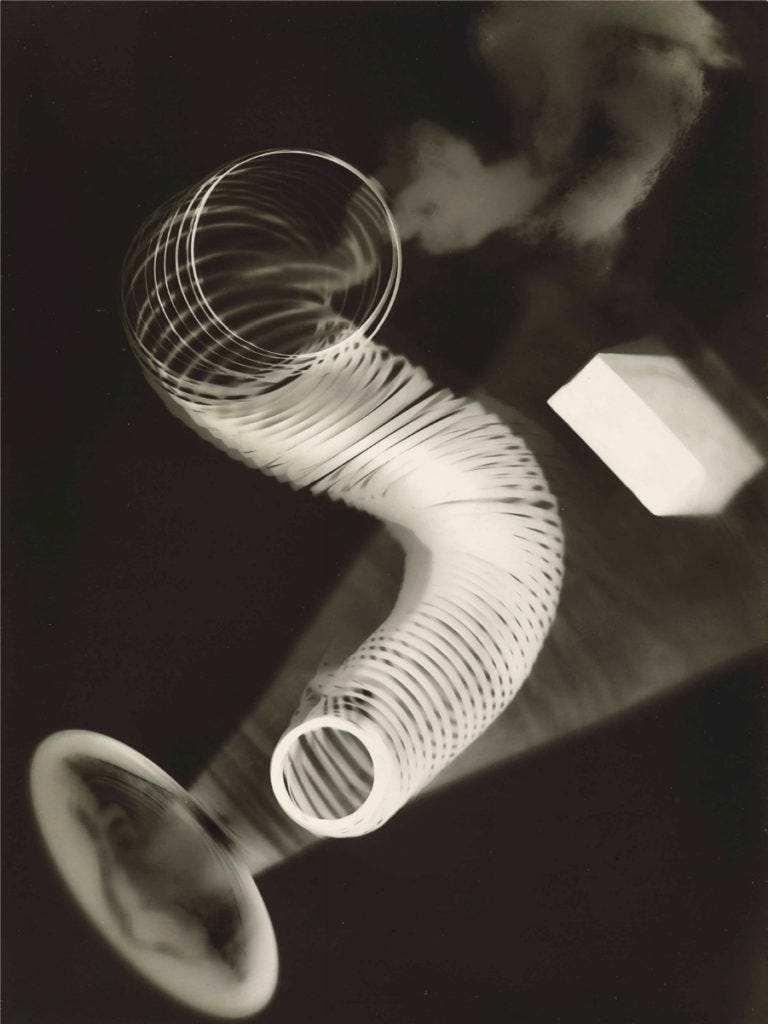
Man Ray wrote the following explaining “his theory about new art for modern life”, or “flattening” life’s intangible realities onto two dimensions, as in a photograph:
“just as the lens sacrifices actual space to focus all that space upon the plate, so the artist must condense the time and space element to create life’s equivalent.”
“A Primer of the New Art of Two Dimensions”, Man Ray
The book and this art exhibit sailed on the tides of my subconscious for a few months now, as I thought about dreams, memory, meaning, and the year anniversary of Nick’s passing this upcoming month. The real in the surreal, the surreal in the real. I’ve never been able to find comfort in anything that has felt untruthful or incomplete, as inconvenient for me as that usually is. But dreams present themselves to me whether they make sense to me or not, whether or not I ask for them. They ask nothing from me, except to experience them.
This Christmas I attended Christmas Eve service for the first time in almost ten years. I was able to appreciate the beauty of the sanctuary in a way I never had before, as I had taken for granted the high ceilings with stained glass windows, the simply carved wooden cross and the enormous organ. This sanctuary used to be a battleground, where I would bristle and second guess the call and response, at the insinuation that God was in control and I had to subjugate my will to him. Now, returning to church a decade later, after experiencing profound grief, I found something different in the same passages that upset me so deeply before. The sermon was about leaving your fears at God’s feet, and trusting in His love. I came away with the thought that maybe ‘God’s plan’ doesn’t imply that everything has meaning, or a “reason”. Maybe “trusting in God’s plan” is as simple as the act of surrender, the humility of not-knowing. Maybe “God’s plan” is unknowable, like the subconscious is unknowable, even as it works in tandem with your conscious mind and brings you dreams every night.
When you fall in love you don’t know it, you feel it, elemental as the tides. I don’t know why this happened, I don’t know the meaning behind suffering, but I know that Nick existed, like a pot that carried water for a time. He had been apart, and now he is a part.
I surrender his memory to my subconscious, it’s a conversation that needs nothing from me but asks gently for a response. Here it is. A dream, an essay, a prayer.
“Current-borne, wave-flung, tugged hugely by the whole might of ocean, the jellyfish drifts in the tidal abyss (…)
But here rise the stubborn continents (…) And now, now the currents mislead and the waves betray, breaking their endless circle, to leap up in loud foam against rock and air, breaking…
What will the creature made all of sea-drift do on the dry sand of daylight; what will the mind do, each morning, waking?”
The Lathe of Heaven, Ursula K Le Guin
As always, every single ball you toss up lands in the most perfect and thought-provoking place
Beautifully said ❤️